Leadership
Leadership Minute: Picture Perfect Parenting
This morning on the way to work I was listening to a podcast and the following question was asked, “Is your family the picture you had in mind.”
That question got me thinking. Whether we admit it or not, we all hold pictures in our mind of how we think our family should look or how our family should “behave.”
Before I got married and had kids my picture looked like this: Dad’s in charge, we have morning devotions together before our breakfast, relaxing evenings together, we never eat fast food….you know…every morning our children wake up and call their parents blessed.
 Well we soon all come to grips with reality and say, “that’s not us” but we (or maybe it’s just me) still feel an incredible pressure for it to be “us.”
The truth is, there is a degree of dysfunction in every family. After all, a family is merely a gathering of flawed human beings. So don’t buy into the myth that we have to make more lists, get more organized, spend more money, and never make mistakes in order to be successful parents. Unrealistic pictures paralyze parents. Remember….our role as mom or dad is not to impress our children with our ability to parent. Our role is to impress our children with the love and nature of God.
I love the following statement by Reggie Joiner, “The family exists, even in its imperfection, to display the heart of God to every generation.”
Instead of looking at your family and wanting a “Better Picture” – shift your thinking and look at the “Bigger Story.”
Leadership Minute: Rate Your Boss as a Leader
Today’s Leadership Minute comes from Clarke Price, former President, Ohio Society of CPAs and a Founder of the Ross Leadership Institute.
 In his classic 1970 book, Up the Organization, Robert Townsend proposed a way to rate your boss as a leader:
Score each characteristic from 0 to 10
My Leader is:
1.. . . . available. If I have a problem I can’t solve, he is there. But he is forceful in making me do my best to bring in solutions, not problems.
2.. . . . inclusive. Quick to let me in on information or people who might be useful to or of long-term professional interest.
3.. . . . humorous. Has a full measure of the Comic Spirit in his make-up. Laughs even harder when the joke’s on him.
4.. . . . fair. And is concerned about me and how I am doing. Gives credit where credit is due, but holds me to my promise.
5.. . . . decisive, Determined to get at those little unimportant decisions which can tie up organizations for days.
6.. . . . humble. Admits his own mistakes openly – learns from them and expects his people to do the same.
7.. . . . objective. Knows the apparently important from the truly important and goes where he is needed.
8.. . . . tough. Won’t let outsiders waste his time or his people’s time. Is more jealous of his people’s time than he is of his own.
9.. . . . effective. Teaches me to bring him my mistakes with what I have learned (if anything) and done about them (if anything). Teaches me not to interrupt him with possible good news on which no action is needed.
10.. . . . patient. Knows when to bite the bullet until I solve my own problem.
Total __________ This is your leader’s rating as a leader on a scale of 0 to 100.
How would your team rate you?
Leadership Minute: 3 Ways to Make Your Vision Contagious
“The only thing worse than being blind is having sight but no vision.” – Helen Keller

People not only follow a person….but a vision as well. The importance of having a vision is even noted as far back as 1000 BC by King Solomon in his book of Proverbs, “Where there is no vision, the people perish.” (Proverbs 29:18).
Visionaries dare to dream. They peer into the future and generate possibilities in their mind’s eye…this is the essence of vision!!
The legendary sculptor, Michelangelo claimed that as he looked into the stone, “I saw the angel in the marble and carved until I set him free.” His vision had already created his masterpieces before his hands did the work.
On the other hand, we have all witnessed a leader present a magical power point presentation, or company memo, detailing his or her new vision for the organization only to see it slowly fade away. These leaders claim to have a vision, but they can never move themselves or others toward it. As a consequence, their vision sits on the shelf until it spoils, or until someone else takes initiative to claim it.
So why does this leader’s vision fail? What makes one leader’s vision powerful and another’s so weak. One word – contagious. In order for one’s vision to be powerful it must be contagious!
How do you make your vision contagious?
#1: By ensuring your vision is clear, challenging, and relevant. Vision provides clarity, not confusion. As John Maxwell says, “vague visions cannot serve as compelling guides.” Followers do not rally behind a leader’s fuzzy picture of the future. Rather, they are attracted and motivated by leaders who can paint an instantly recognizable portrait of tomorrow.
#2: By living it out. The key leaders within the organization must be the first to truly and fully participate in the vision. They have to let others see and feel their personal passion for the vision through their own participation. Simply put…the leader is the steward of the vision he casts.
#3: By continually casting the vision. To paraphrase Andy Stanley: You can’t just cast it once. You must cast it continuously and convincingly. You most work to ensure everyone on your team knows they also have a responsibility to cast and carry the vision. Your team’s mindset should be: “If we don’t do it, it won’t get done.”
Is your vision contagious? More importantly, do you even have a vision? As Theodore Hesburgh, President Emeritus of the University of Notre Dame stated, “The very essence of leadership is that you have a vision.”
Baseball and Leadership Development
One of the highlights of summer in my house is the Little League World Series. My boys love watching kids their age play one of the sports they love. They especially enjoy the introduction of each player. In front of a national TV audience, the young baseball players have a chance to state their name and their favorite player. I was amazed at how many kids stated Derek Jeter (who retired at the end of last season) as their baseball hero.
 I am not a huge Yankees fan, however I can respect the legacy of success and hard work that Jeter is leaving behind. During one of the commercial breaks, my youngest son asked me, “How did they find someone to take his place?” In a simple way I attempted to explain the MLB’s farm system. I shared how teams use the minor leagues to develop talent and produce a new crop of young players.
My oldest son, more savvy to sports, then mentioned how teams also “buy” talent through free agency. This is also true. Some teams, instead of developing their own talent, pay big money and sign a free agent from another team.
What about you….do you have a minor league leadership development system or do you depend on free agency?
As a leader within your organization ask yourself the following questions:
· Are there stars on my team nearing the end of their service?
· Who are the rising stars on my team?
· Do I have an intentional, programmed leadership development plan for my team?
· If one of my team members were absent for an extended period of time (similar to the D.L. in sports) have I identified talent to fill the hole or would I need to go the free agency route and hire someone new?
Remember…free agency is not necessarily bad. If you develop the talent on your team well, another organization may come calling for one of your team members. When they do, you’ll ensure that person is supported and equipped to go. You’ll then go to your bull pen and call up your next rising star!
Family Core Values

In my previous organization, we had a list of 3 core values: Honor, Courage, and Commitment. As Marine leaders, we consistently led numerous discussions on how these values were lived out and demonstrated by individual Marines and collectively as a warfighting organization. More importantly, we were expected to model them on a daily basis.
Realizing the importance of core values in my “job” solidified the need for my family to define our own set of values. Over time and after much prayer and discussion we came up with five.
Our Core Values are:
Prayer with Expectation
Truth with Compassion
Scripture with Application
Generosity without Reciprocation
Leadership with Humility
(*I’ll save future blog posts to describe each one and why they are important to us*)
The purpose behind defining your family core values is not to have something nice to put in a frame or hang on the fridge, but a clear list of values that drive your decision making and provide focus for how you “do life.” To paraphrase author and leadership consultant Will Mancini, core values are the shared convictions that guide our actions and reveal our strengths. Simply put, they should be a constant reminder of what is important to your family.
When you don’t know or you haven’t clearly defined your values, you end up drifting along in life. Instead of basing your decisions on an internal compass, you make choices based on circumstances and social pressures. Conversely, when your family’s core values are clearly defined the benefits are numerous:
- Provides a framework to make individual and family decisions
- Helps ensure unity
- Makes life simpler because it frees you to say “no” to certain things and “yes” to better things
- Most of all: core values allow you to do more of what you do best!
Your family already has a certain set of core values….maybe you just haven’t clearly defined them yet. They are underneath the surface of your daily activities. Your role as a leader in your home is to pull them above of the waterline. The more your family knows about itself, the better it’s able to deal with life. Trust me… there’s something about actually writing down your values that makes you more committed to living them out!
The Purple Heart and the Gospel
“In love’s service, only the wounded soldiers can serve.”
On this day in 1782, General George Washington, the commander in chief of the Continental Army, created the “Badge for Military Merit,” a decoration consisting of a purple, heart-shaped piece of silk, edged with a narrow binding of silver, with the word Merit stitched across the face. As a testimony to the award’s honor, Washington only awarded the medal to three soldiers.
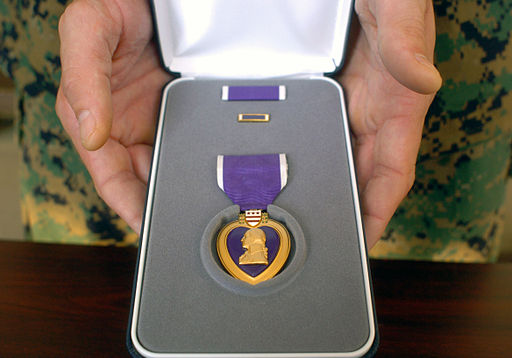 The decoration was largely forgotten until 1927, when General Charles P. Summerall, the U.S. Army chief of staff, unsuccessfully encouraged Congress to reinstate the award. Four years later, Summerall’s successor, General Douglas MacArthur, took up the cause, hoping to reinstate the medal in time for the bicentennial of Washington’s birth. On February 22, 1932, Washington’s 200th birthday, the U.S. War Department announced the creation of the “Order of the Purple Heart.”
The Order of the Purple Heart, considered the oldest American military decoration for military merit, is now awarded to members of our armed forces who have been killed or wounded in action against an enemy. I have numerous friends who wear this medal. All their medals and awards tell stories, however this one has a physical and mental cost that they continue to pay. These men are truly warriors.
If life awarded purple hearts we would undoubtedly all have one, most of us probably many. We have all suffered wounds from self-inflicted actions and wounds as the result of others in our life. Similar to treatments and therapy for physical wounds, thankfully there is a healing answer to the wounds we all carry…the Gospel of Jesus Christ.
At the heart of this good news is a narrative of creation, brokenness, and reconciliation. Simply put, it is a story of redemption. The great thing about redemption is that although our wounds and scars are earthly, they are not eternal.
Leadership Minute: The Problem with Success
“Success can close a mind faster than prejudice.”
As a Marine, I was used to moving in and out of assignments every 2 to 3 years. 2010 was another one of those transition years.
 As I checked into my new duty station, I started my initial observations and began to discuss my thoughts on a few areas in need of change or update. However before I made any adjustments I wanted to ensure I understand “why” we did certain things. As I spent time inquiring as to the reasoning behind certain decisions and policies, I ran directly into what I call the “But Sir” Proverb, “But Sir, that’s the way we have always done things.”
Over the last 19 years I have noticed that although a great thing, success can actually obstruct an organizations growth. As noted by Peter Drucker, “No one has difficulty getting rid of total failures. Yesterday’s success however, lingers on long beyond its productive life.”
The major danger with lingering success is that it doesn’t require new critical thinking. If left unchecked, the easiest course of action for any problems that may arise is usually the one previously taken . . . . especially if it was successful.
What about you, are you allowing yesterday’s success to cause tomorrow’s failures?
Leadership Minute: Leadership Isn’t Convenient
Leadership Minute….a quick read to provide my thoughts on certain aspects of leadership. I welcome your feedback!

A great friend and mentor of mine lived and preached two great philosophies concerning leadership:
#1: Leadership is a Contact Sport
#2: Leadership Isn’t Convenient
Let’s hit #2 today.
How much of your day is spent answering questions or problem solving with members of your team? When they walk away, did they leave with answers, guidance, and clarity?
Today’s pace and demand in the work place can challenge even the best time-management expert; however it is important to pause and listen to members of your team. They are not an interruption, they are an obligation. Remember…..you’re the leader.
A few years ago I read the biography of former Army General and Sec. of State Colin Powell. He made a simple yet powerful observation, “The day your soldiers stop brining you their problems is the day you stopped leading them. They have either lost confidence that you can actually help or concluded that you do not care. Either case is a leadership failure.”
Ask yourself today, “Do I provide leadership when it is convenient – or when it is needed?”
Talking With My Kids About Terrorism
Thursday was a mix of emotions for many, my family included. Earlier in the morning, a dear friend of mine, returned to his family after a lengthy deployment. His unit was gone over 7 months. Similar to the other Marines he was deployed with, he missed birthdays, school parties, anniversaries, and holidays. His wife and two kids simply missed him. On this day, their countdown was finally over. A husband came home to his wife. A daddy came home to his kids. The joy of reunions are indescribable to those who have not experienced them. This was a great day for hundreds of Marines and their families.
Then a little after 11am news broke that a young man named Mohammad Youssef Abdulazeez sprayed an Armed Forces Recruiting Center with gunfire before driving seven miles away and killing four Marines at a Navy Reserve Center. Although the investigation continues, there are no answers that will truly satisfy our desire to know “why?”
Within a few hours on Thursday, a number of families were reunited with their Marine while four other families, through an act of terrorism, had the fabric of their lives destroyed. The contrast in emotions was overwhelming.
My boys had questions about both events. As I spoke with my children over the next two days I wanted to ensure they understood four things:
#1: There is evil in this world. This cannot be ignored. We can refuse to watch the news or read the articles but that will not make it go away. In fact, one of the great fallacies of our modern life is the assumption that we have the right to live in peace and security. The plain truth is Jesus never promised us safety in this world…quite the contrary.
#2: Our response to this evil is not simple to explain or understand. There is no one right way to face evil. God may call us to fight and conquer like Joshua, submit with hope like Jeremiah, or preach like Jonah. But, even in light of these examples, we must remember that the One we are told to emulate is Jesus…His love and His sacrifice.
#3: I reminded my boys that strong people always stand up for victims . That’s why we have a military, local police, first responders, etc… All of these men and women are willing to sacrifice to allow us to sleep peacefully in our bed each night. They sacrifice their personal comfort, their freedoms, and many even their lives, to protect and defend us. However the burden to protect and serve others does not fall solely on their shoulders….we must also do our part to protect those who may be weak. Regardless of our response, to overcome this evil, service and sacrifice is required.
#4: Perhaps most importantly I remind them of who wins in the end. “And the devil, who deceived them, was thrown into the lake of burning sulfur, where the beast and the false prophet had been thrown. They will be tormented day and night for ever and ever.” – Revelation 20:10.
Change of Direction
In most all military boot camps, one of the first things a new recruit is taught is close order drill…or for the non-military type…marching. The drill instructors use drill to teach discipline by instilling habits of precision and instant obedience to orders, to build unit cohesion, and to provide simple formations from which combat formations may be readily assumed.
 First the first few weeks the recruits spend hours upon hours learning drill through continuous repetition. Some movements are quickly grasped while others are quite painful. I remember clearly the two most difficult drill movements for me and my unit to learn: “About Face” and “To the Rear”.
“About Face” is a standing individual movement while “To the Rear” is a marching movement used by the entire unit. Both drill movements serve the simple purpose of turning the individual or the unit 180 degrees in the other direction.
History provides us with great examples of men and women who have chosen to change the course of their life for the better. I was sharing with my children recently the story of a man, living centuries before, who changed the negative direction his life was taking. His name was Paul, formerly known as Saul of Tarsus. Known as a relentless persecutor of the early church, he was determined to stop the spread of Christianity. But after a dramatic conversion on the road to Damascus, Paul devoted the rest of his life to preaching the gospel and building the church. Today we remember him as a missionary, church planter, and author of thirteen New Testament epistles.
For my boot camp platoon, Platoon 1003, once we individually and collectively learned the difficult tasks of changing our direction we were able to move on to advanced training, graduate as Marines, and fulfill our purpose in serving others. And as Paul clearly shows us, it doesn’t matter how far off course you’ve gotten; it isn’t too late to change your direction.
 Brad Flurry